The Language of the Beautiful Game
You can hear it, even with the sound off. A low, collective hum that swells into a roar, punctuated by groans, gasps, and the sudden, explosive eruption of pure joy. This is the soundtrack of the FIFA World Cup, a global conversation that transcends borders. But to truly understand the story unfolding on the pitch, you need more than just passion; you need the vocabulary. The language of football is rich, specific, and often wonderfully poetic. It’s a dialect where a single word can conjure the agony of a near miss or the genius of a perfect pass. For any fan, new or seasoned, unlocking these English terms is the key to a deeper, richer appreciation of the world’s greatest sporting spectacle.
The Pitch: Where the Drama Unfolds
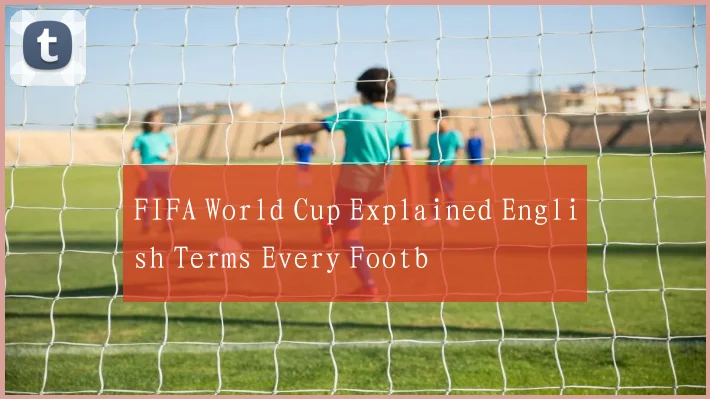
It all starts here: the hallowed rectangle of grass. But to call it simply a "field" is to miss the nuance. This is thepitch, a stage set for glory and heartbreak. At either end, guarded by the solitary, often heroic figure of thekeeperorgoalkeeper, stand the goals, framed by thepostsand thecrossbar. The final third of the pitch near the opponent's goal is ominously known as thefinal thirdor theattacking third, a zone of heightened tension. Then there’s thebox—or more formally, thepenalty area—that sacred, nerve-wracking rectangle where dreams are made and shattered. A foul here results in the ultimate test of nerve: thepenaltyorspot-kick, a one-on-one duel from twelve yards that can define a player’s career.
The Cast: More Than Just Players
Twenty-two individuals take to the pitch, but their roles are as distinct as those in a symphony orchestra. The last line of defense, thesweeper-keeper, is a modern evolution, a goalkeeper who acts almost as an extra defender, rushing out to clear danger with their feet. In front of them, theback four(orback three) forms the defensive spine, withfull-backspatrolling the flanks andcentre-backsorstoppersengaging in aerial battles. The engine room is midfield, where theholding midfielderornumber sixbreaks up play, while thebox-to-box midfieldercovers every blade of grass. The magicians are theplaymakersornumber tens, tasked with unlocking defenses with a visionary pass, a "through ball" that slices the opposition open. Up front, thetarget manuses strength to hold up play, while thepoacherlives for a single touch inside the box, and thefalse ninedrops deep, creating chaos with deceptive movement.
Key Player Roles in a Nutshell
- Sweeper-Keeper:The proactive goalkeeper, an 11th outfield player.
- Holding Midfielder (The "6"):The shield, the destroyer, the first line of defense.
- Playmaker (The "10"):The conductor, the eye of the storm, the creator of chances.
- False Nine:The tactical illusion, a striker who isn't always a striker.
The Action: Narrating the Flow of Play
The ball is in motion, and the commentary is a rapid-fire narration of skill and strategy. A long, searching pass from deep is along ballor a hopefulhoof. A more precise, aerial pass from the wing is a deliciouscross, waiting to be met with a powerfulheader. When a player beats an opponent with sheer speed and control, they’ve taken themon the dribble. A perfectly timed, last-ditch tackle is aslide tackle—legal, but risky. When the referee spots an infringement, he may play theadvantage, allowing the wronged team to continue their attack if they have the ball, a moment that requires quick thinking from everyone. And when a team loses possession cheaply in a dangerous area, they’ve been caught on thecounter-attackorcounter, facing a terrifying surge of opposing players.

The Set-Piece: A Rehearsed Moment of Chaos
In the tightest knockout games, where open play is stifled, matches are often won and lost in these frozen, strategic moments. Theset-pieceis a restart of play from a dead ball, a chance to unleash a rehearsed routine. The most common are thecorner kickand thefree kick. For a directfree kickjust outside the box, fans hold their breath as a specialist steps up, eyeing the "wall"—a line of defenders trying to block his path. The ball can be whipped, curled, or driven with terrifying power. On acorner, giants from both teams jostle in the box, waiting for the delivery. A clever, short corner is aset-piece variation, designed to catch the defense napping.
The Officiating & The Fan's Lexicon
The man in the middle holds the whistle, and his decisions are parsed with intense scrutiny. Abookingis a caution, shown by ayellow card. A second yellow, or a grievous foul, results in ared cardand anearly shower—a sending off. The assistant referee on the touchline, once called a linesman, now holds the flag foroffside, the rule that prevents "goal-hanging." And in the modern game, theVideo Assistant Referee (VAR)has added a new layer of drama, a voice in the official's ear that can recommend a review for a "clear and obvious error," leading to agonizing waits and overturned decisions.
Finally, there is the language of the stands and the sofa. A dominant performance is amasterclass. A player in sublime form ison fireor has "tekkers" (technique). A terrible miss is asitter. And when a smaller team defeats a giant, it’s a classicgiant-killingorcup upset.
More Than Just Words
These terms are more than jargon; they are the building blocks of the World Cup narrative. They allow you to anticipate a counter-attack before it happens, to appreciate the selfless run of a player creating "space," and to understand the tactical battle between managers from the touchline. When you hear a commentator say a team is "playing ahigh line" or trying to "park the bus," you’re not just listening—you’re seeing the chess match unfold. So, as the next World Cup cycle builds, and the world once again turns its eyes to the pitch, listen closely. You’ll hear the story of nations written in tackles and through balls, in set-pieces and last-ditch clearances. Now, you’ll understand every word.